
Ground breaking Invention by two young Pakistani brothers Aurangzeb Mufti and Zohaib Mufti stunned the technology community by inventing Home/Office Building Automation and Security System. Their innovation not only won first place at most reputable Software competition in Pakistan held at NED University of Engineering & Technology but also attracted international media coverage. At a time when IoT was still an emerging buzzword in the West, the Mufti brothers had already showcased how everyday convenience could be managed remotely through a mobile phone.
The Spark That Started It All: An Invention That Planted the Seeds of a Journey Still Inspiring Today
Today, Aurangzeb Mufti has transformed that vision into a professional career dedicated to Smart Cities, AI-powered integration, and green building infrastructure. Currently leading design and engineering initiatives across the Middle East and beyond, he is at the forefront of developing next generation, sustainable urban ecosystems. A key focus of his work is the application of AI and IoT (Smart Home/Office Automation) to maximize energy efficiency and environmental performance in buildings.
Aurangzeb Mufti’s journey from youthful inventiveness to Smart City leadership shows how innovation, when paired with security conscious design, can redefine urban living. His work is not just about technology, it’s about creating ecosystems where people, infrastructure, and the environment thrive together.
Why Smart Buildings (Smart Home/Office Automation) Matter: The Focus on Sustainability
Buildings consume over 40% of the world’s energy. Traditional systems rely on static schedules and manual monitoring leading to wasted energy, higher costs, and poor occupant experiences.
This is where AI-powered IoT (Smart Home/Office Automation) is changing the game. By enabling buildings to think, learn, and optimize themselves, smart systems are not just about efficiency but about creating healthier, adaptive, and environmentally positive environments for the people who live and work inside them.
Smart, Green, and Sustainable: AI and IoT Shaping the Smart Buildings of Tomorrow
1. Smarter Energy Management and Saving
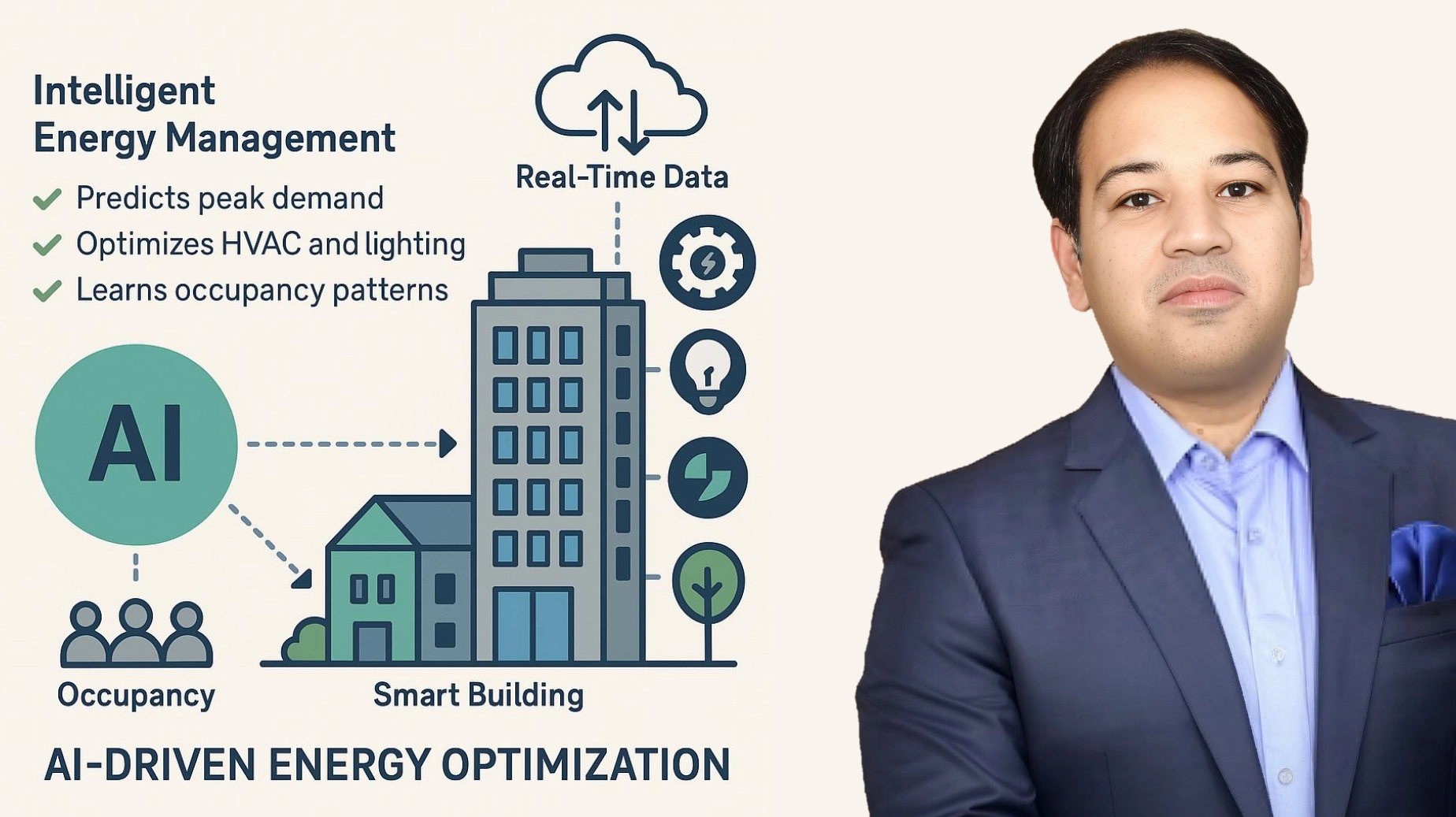
Every light, HVAC unit, and water outlet can now be connected to IoT sensors. AI analyzes usage patterns to:
- Predict peak energy demand and balance loads.
- Optimize lighting, heating, and cooling dynamically to reflect real-time needs.
- Learn occupant behavior and automate routines for maximum efficiency.
- Impact: Energy use can drop by up to 30%, significantly reducing operational costs and carbon emissions.
2. Maximizing Renewable Energy
AI predicts solar/wind availability and distributes energy intelligently. Combined with smart storage, this brings buildings closer to net-zero energy goals.
- Impact: Strong sustainability credentials and a dramatically reduced environmental impact.
3. Predictive Maintenance
IoT sensors continuously monitor system performance. Instead of waiting for failures, AI predicts issues before they happen.
- Equipment lasts longer, reducing resource consumption.
- Downtime is minimized, ensuring reliable and smooth operations.
- Impact: Higher reliability in mission-critical systems and lower overall maintenance costs.
4. Enhancing Occupant Experience and Wellness
Smart buildings are human-centric, adjusting dynamically to improve productivity and comfort.
- Real-time adjustment of air quality, lighting, and temperature.
- Personalized workspaces in offices or homes.
- Data-driven insights to improve well-being.
- Impact: Happier tenants, higher property value, and stronger workplace performance.
5. Cybersecurity and OT Foundation
Though the focus is on green technology, the foundation must be secure. Every connected device represents a potential cyber risk. Aurangzeb acknowledges that robust cybersecurity is foundational: it ensures that Smart Buildings are resilient against threats, protects sensitive data, and maintains the continuity of critical services like energy management.
Aurangzeb Mufti is now helping shape projects that integrate Digital Twins, AI-driven Fire & Life Safety systems, and intelligent access control into Smart Buildings and City frameworks. These innovations are not only enhancing convenience but also aligning with the global push for sustainable urban development.
“The next generation of cities will be self-learning,” Aurangzeb notes. “Buildings will predict, adapt, and optimize every aspect of energy use and occupant experience. That’s the real revolution making cities both smarter and greener.”
The Mufti brothers’ story is no longer just about a prize-winning invention; it is a testament to vision, perseverance, and the continuous reinvention of technology. From designing and coding systems in leading Smart City projects on an international scale, their journey exemplifies what Pakistani innovators can achieve on the global stage.
Imagine a building that thinks for itself, saves energy, and keeps its occupants safe and happy. That’s not science fiction, it’s the smart building revolution, and innovators like the Muftis are helping make it a reality.